Exactly
gamefinity.io · Math & Logic
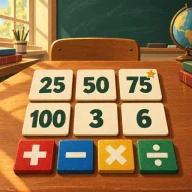
Shares Nerdle's arithmetic but asks you to build the equation yourself: you combine six numbers with the four basic operations until they equal the target, three puzzles a day from easy to hard.
Nerdle is Wordle for arithmetic: you have six tries to find a hidden equation eight characters long, digits and symbols included, and every guess has to be a valid calculation itself. Green, purple and black tiles show which characters are in the right place, in the wrong place or missing. The fun is that the math constrains the answer, so knowing where the equals sign sits narrows the options sharply.
The list opens with a daily target-number game for anyone who enjoys the arithmetic itself, then the closest equation-guessing relatives of Nerdle, and then number logic puzzles that keep the satisfaction of a sum that finally works out.
Shares Nerdle's arithmetic but asks you to build the equation yourself: you combine six numbers with the four basic operations until they equal the target, three puzzles a day from easy to hard.
Nearly the same deduction with one extra clue: the target result is shown, and each six-symbol guess must equal it, so you work backward from a known answer.
Gives you the operators in fixed positions and a target result, and you guess the missing digits over five tries, with colored hints like Nerdle's.
The puzzle is a prime number of five digits, and each guess must be prime too, a rule that works like Nerdle's demand for valid equations.
Countdown-style arithmetic where the given numbers must be combined to reach a target, plus a second target to chase for extra credit.
Reach a target by chaining sums, spending each tile only once but carrying subtotals forward, in five steps at most, a tidy daily test of planning ahead.
Turns arithmetic into elimination: strike out cells so the numbers left in every line hit the totals printed at its edge, on 5x5 or 7x7 boards against a timer.
Places domino pips so every row and column reaches its total, a sum-checking puzzle that rewards the same careful arithmetic as Nerdle's equations.
Applies Nerdle-style color feedback to a different code: guess an entire chess opening move by move in six tries, with an expert mode that lengthens it.
Another deduction puzzle with six tries: work out the five community cards from three face-up poker hands and a chart of how they rank on each street.
Cracks the hex code of a color one digit at a time, as every position tells you whether to go up, go down or stay, a numeric code-breaking loop much like Nerdle's.
Green marks a character that is correct and placed right, purple one that belongs in the equation at another position, and black one that is not used. A digit or symbol can repeat in an answer, so a purple 1 does not rule out a second 1 somewhere else.
Yes. The Nerdle site runs several variants beyond the classic eight-character puzzle, including Mini Nerdle with six characters and a larger Maxi version. For an equation game with the result given up front, Mathler and Calcle on this list are the closest relatives.
Yes. Multiplication and division are worked out before addition and subtraction, so 3+2*4 equals 11, not 20. The right side of the equals sign must be a plain number rather than another calculation, which limits where the equals sign can sit and makes a useful starting clue.