










Daily IQ
gamefinity.io · Math & Logic
Ten reasoning puzzles with no timer, though quicker answers earn a higher score.
Pure reasoning, a new puzzle a day. Here you will find deduction mysteries, number guessers in the Wordle mold, grid puzzles with one clean solution, and a few chess and card puzzles for good measure.
None of them need an account. Most take five to fifteen minutes, and the hardest ones are worth a second cup of coffee.
Ten reasoning puzzles with no timer, though quicker answers earn a higher score.
Use the clues in the soil to locate a buried object within six digs, then move on to the next site until the day ends.
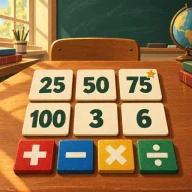
Combine six number cards with plus, minus, times and divide to land on the target. Three sums a day.
Set five odd weights on a brass balance and try to make it come to rest perfectly level.
Choose a whole number up to 100. The guess nearest a set fraction of the day's average wins, so you are really predicting everyone else.
Find the checkmating move in puzzle after puzzle taken from real games, against a ninety-second clock.
Six-by-six sudokus on a clock that gains time with every grid you finish.
Deduce a hidden eight-character equation, digits and operators included, in six tries, with Wordle-style colors showing which symbols sit in the right place.
Work out a secret six-symbol equation that hits the posted target, in six tries, where each attempt must also evaluate to that target.
Combine the given numbers with addition, subtraction, multiplication and division to hit a target, Countdown style, with a bonus target for extra credit.
Twenty characters fill a grid, and each revealed clue helps you mark people as innocent or criminal; puzzles grow harder from Monday to Sunday.
Crack a short murder mystery by cross-referencing suspects, weapons and locations in a logic grid, with a gentler mini for newcomers, from author G. T. Karber.
Classic 9x9 number placement from the Times, offered as three separate grids graded easy, medium and hard.
Lay dominoes onto a board of colored regions so each region's pips meet its rule, such as a target sum or matching values, at three difficulty levels.
Standard sudoku from the L.A. Times at several difficulty levels, with a browsable archive and free registration for streaks and timing.
Einstein-style logic puzzles: read a list of clues about people standing side by side and deduce each one's attributes, with past puzzles and printable versions.
Reach a target number by chaining sums of the number tiles in at most five steps, using each tile once and reusing subtotals in later sums.
Strike out numbers until every line across and down totals the target at its edge, against a running clock, with 5x5 and 7x7 boards.
Wordle for numbers: guess a five-digit prime in six tries, with every guess required to be prime and colored by digit placement.
A fresh brainteaser, riddle or word puzzle from Kevin Stone's ad-free BrainBashers, with a hint, a worked answer and a printable version.
Light Up, also called Akari: place bulbs so every white cell is lit, no two bulbs see each other, and numbered walls get the right count.
Cover the grid with domino pieces so that the pip totals along every line, across and down, hit their targets; the game is also on Steam.
Tap a tile on the lowest row to remove it and its matching-color neighbors, letting the stack drop, and clear the board in the set number of moves.
Memory meets sudoku: flip hidden tiles two at a time to find matching numbers, gradually revealing a full grid where each digit appears nine times.
Shade each cell one of two colors so every connected field matches the size its number calls for, in this Inkwell Games logic puzzle.
Drop stars onto a grid of shaded regions so none touch and each row, column and region holds its required number, in this Inkwell Games puzzle.
Minesweeper boards that never force a coin-flip guess, with no game overs, free hints, and a new oddly sized challenge board each day alongside the standard sizes.
Locate eight hidden queens, one per row and column and never touching diagonally, using Minesweeper-style numbers that count adjacent queens.
Shade squares on a nonogram using the run-length clues along every line to uncover a hidden pixel picture, with a tutorial for beginners and a large archive.
Supply the missing digits of an equation with a fixed layout of operators so it equals the number shown, in five attempts with color feedback.
Seat each person on a grid by following their clues to locate the day's relic, with a Mosaic shape puzzle and a Rosetta-style language decoding challenge alongside.
Find the winning line in a single tactical position picked by Chess.com, where the puzzles are set to grow tougher as the week goes on.
Pulled from a real online game, one tactics position asks you to spot the strongest move and play out the rest of the line, no account needed.
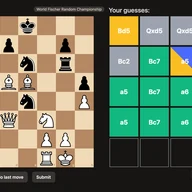
Starting from a position in a real game, predict the five moves that followed; colored tiles show exact hits, moves in the wrong slot and right piece types.
Work out an entire chess opening, white and black moves alike, in six attempts with Wordle-style colors on each move; expert mode stretches it to five moves per side.
Three Texas Hold'em hands sit face up beside a chart ranking them on each street; deduce the exact five community cards within six tries.
Drop cards one by one into a grid, building poker hands across rows, columns and the four corners to score as many as you can.
Pieces are handed out at random instead of the standard setup, so opening theory is useless as you hunt for a checkmate against the black king.