Where?
where.roughly.is · Geography
Slide an unlabeled world map until the crosshair sits inside an animal's real range, guided by its silhouette and name, with misses measured in distance over five rounds.
DailyPlay ↗
Page 5 of 5: 39 games, from Where? to Read the World. The shelf’s first page starts with the games to try first.
Slide an unlabeled world map until the crosshair sits inside an animal's real range, guided by its silhouette and name, with misses measured in distance over five rounds.
Four legs of geography in one run: hunt a secret city by distance, judge nine country size match-ups, name a nation's neighbors and cross a map by borders, out of 50.
List every land neighbor of the day's country, typos forgiven but each wrong country a strike, three strikes out, with difficulty climbing from Monday to a Sunday giant.
Decide whether each next country sits above or below the last on the day's statistic, such as population, across 15 calls with three lives to lose.
Find a secret world city with no starting clue by naming any city and reading its exact distance from the target, closing in with the fewest guesses you can manage.
Trace the course of a river or mountain range from source to mouth on an unlabeled map in one stroke, then see the real line drawn over yours, scored on the gap.
Drag a city's outline to the size of its real built-up area beside another city at the same scale, like Boston next to Rome, then see the true square mileage.
Track down the mystery country in eight guesses from each miss's continent, hemisphere, size, population, distance and direction, or try flag, emoji or picture modes.
Six stages center on one country each day: name it from its outline, pick its neighbors, then match capitals and flags and compare areas and populations.
Pick the right species for the animal in a photo from a list of close look-alikes, with four attempts and creatures ranging from mammals to amphibians.
Each round shows two pairs of capitals; pick the pair that sits nearer together, over five rounds in which the two distances keep converging.
Choose a city for every square of a 3x3 board that fits the clue on its row as well as its column, with nine guesses and a rarity score where less common picks win.
Five attempts to name a mystery city from stamped clues like temperature and population, with elevation, local time, landscape and airlines unlocking as you miss.
Pinpoint which airport is hidden from a map of the nonstop destinations it serves, with each miss giving distance and direction and showing more routes.
Pin three named cities on a featureless 3D globe with no borders or labels, working out each spot from a reference point, with the day's difficulty rated out of ten.
Figure out what a real data map shows from its color shading alone, peeking at three regions' values, with each miss revealing category, unit or a hint.
Pick a country for each cell of a 3x3 board that matches its row and column traits, with 12 guesses and more points for smaller, less obvious nations.
Route a trip from one airport to another over real airline connections without overspending the budget or the time cap, while chasing three bonus challenges.
A tight close-up of a country's flag widens with each miss; name the country in five guesses, with a continent hint after the first wrong one.
Look around a 360-degree street-level panorama, then click on a map of the world to mark where it was taken, with five guesses and distance shown after each.
Locate a run of countries on a world map as quickly and precisely as you can, scoring extra for speed and accuracy, with a hard mode on offer.
Set the compass heading you would leave on to follow the shortest great-circle path between two cities, a puzzle about how a round Earth bends directions.
Point to where named countries sit on a blank, label-free globe, relying on your own mental map of the world to place each one.
Identify a mystery city from a 3D model that builds up from bare terrain through weather, water and roads to buildings, with five guesses.
Ten world-trivia questions a day in about two minutes, with speed-weighted points and the option to host live rooms friends join by code.
Look around a Street View scene for clues, then name which of the 50 US states it is in, picking from a list of every state.
Hunt down a hidden country as each fact you choose, about size, cities or nature, rules out roughly half the world map until one answer remains.
Place a flag in each cell that satisfies its row and column rules, such as containing black, showing a bird or lacking orange, within 15 guesses.
Solve the rows of a geography crossword whose answers together reveal one mystery country, with optional first-letter hints if you stall.
Look at a photo of a plated dish and name its country of origin, with four guesses to land on the right cuisine.
Draw a single line across the map that divides the day's statistic, such as population, area or GDP, as evenly as possible between both sides.
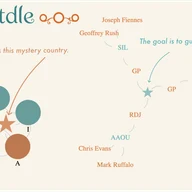
Identify a mystery country from a network diagram of its neighbors, where node color, size and shading show coastline, land area and population.
Find the point on the far side of the globe from a marked location, naming the country, ocean or sea there in five guesses with warmer and colder hints.
Given one country with no name or lines shown, sketch its outline on a 3D globe from memory and earn a score out of 100 for matching both its area and its edge.
Sketch five countries' outlines from memory, with faint pieces of the true border to guide you that shrink each round, then watch the real shape draw over yours.
Track down a mystery American college in eight tries with feedback on distance, enrollment, school colors, acceptance rate and type, at several difficulty levels.
Find a named country on a fog-covered globe where each nation is covered by its own flag, tapping to clear circles of fog and reading flags to locate it in few taps.
Follow a raindrop from where it lands, like Bogotá, downhill to wherever its water reaches the sea or a lake, tapping the map with four tries to get within 100 km.
Deduce a mystery country from the five Wikipedia articles its people read most the day before, using six guesses with feedback after each miss.