Mcdle
mcdle.net · Gaming
Stays in the Minecraft world: a daily mob, block or item to identify from clues with no cap on attempts, plus a crafting quiz built on the recipe knowledge Minecraftle relies on.
DailyPlay ↗
Minecraftle asks you to craft a secret Minecraft item from the ingredients in your inventory, and you have ten guesses to get the recipe right. After each wrong attempt the crafting grid lights up: grey rules an ingredient out entirely, orange means it belongs somewhere else on the grid, and green means it sits in the right slot. Daily and Random modes are available, and the game was first built in 2022 by four developers, including Zach Manson, who hosts it. Its pleasure is recipe knowledge meeting logic.
Minecraft puzzles come first, including one with its own crafting quiz. After those are games that share Minecraftle's slot-by-slot feedback, telling you whether a piece is right, misplaced or absent, whether the pieces are colored pegs, chess moves or ranked items. A recipe guesser from the kitchen and a multi-game hub that includes Minecraft round out the list.
Stays in the Minecraft world: a daily mob, block or item to identify from clues with no cap on attempts, plus a crafting quiz built on the recipe knowledge Minecraftle relies on.
A set of Minecraft brainteasers, among them a crafting chain, a hive of recipes, a 3x3 puzzle of items and a mob to name, with several resetting each day, so recipe fans get more than one puzzle.
Swaps crafting for creatures: today's secret is a Minecraft mob, and every guess is checked for how it behaves, where it lives, its health and height and which update added it, with extra hints arriving later.
Sixteen Minecraft tiles to sort into four groups of four, with themes that can hinge on small details such as how many of an item stack together, so close knowledge of the game pays off.
Shares Minecraftle's feedback logic in its purest form: a four-color code must be deduced from rows of clues already given, with solid pegs marking a correct color in its correct place and hollow ones a correct color misplaced, like orange tiles.
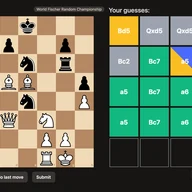
Brings the same color logic to chess: from a real game's position you predict the following five moves, and the tiles mark exact hits, moves that occur but at another point in the sequence, and moves that at least used the correct piece.
Five items to put in order on a single scale, hot peppers by heat for instance, with three tries. Anything already in its right position goes green and locks, a slot-by-slot check much like Minecraftle's grid.
Another ordering puzzle with positional feedback: five things such as mountains are sorted by a measure over four checks, and each check reveals only which positions are correct, leaving the rest to deduction.
A crossword of 5x5 or 7x7 squares where every entry is solved with Wordle-style color feedback, with as many tries as the word has letters, so as in Minecraftle you fill a grid by reading which pieces sit right.
A secret recipe from the kitchen instead of the crafting table: each dish you guess is compared on cuisine, ingredients, method, taste, cooking time and more, and you have eight tries to find it.
A multi-game hub where Minecraft sits beside League of Legends, Valorant and CS:GO. Choose a game and work through four daily guessing modes covering things like mobs, skins and maps.
After a wrong attempt, a grey square means the ingredient placed there is not part of the recipe at all, orange means it is needed elsewhere on the crafting grid, and green means it is the right ingredient in the right slot. Code-breaker uses the same idea with solid and hollow pegs on a four-color code.
Yes. Besides the Daily puzzle there is a Random mode for extra recipes, a stats page that tracks how you are doing and a High Contrast setting. For more Minecraft knowledge puzzles, Mcdle has its own crafting quiz and MinePuzzle offers a crafting chain and a hive of recipes.
Minecraftle was created in 2022 by Tamura Boog, Zach Manson, Harrison Oates and Ivan Sossa Gongora, with other contributors listed on its GitHub repository. It was first built with Flask and later rebuilt with Next.js and React, and Zach Manson hosts it today.