Yugiohdle
bingedle.com · Math & Logic
Name the Yu-Gi-Oh card of the day, with each guess checked against its ATK, attribute, monster type, level or rank, card kind and series of origin.
DailyPlay ↗
Page 5 of 10: 40 games, from Yugiohdle to Weft. The shelf’s first page starts with the games to try first.
Name the Yu-Gi-Oh card of the day, with each guess checked against its ATK, attribute, monster type, level or rank, card kind and series of origin.
Hit five target numbers of rising difficulty by combining six given numbers with addition, subtraction, multiplication and division, using each number once.
Tap pieces in the right sequence to land each one on its matching beacon, where sliders glide until blocked and pushers shove one square before reversing.
Each cell of a three-by-three board takes an answer from the day's topic, such as countries, that matches both its row and column clue, with limited lives.
Shade squares on a ten-by-ten grid to satisfy the number clues along every row and column, bringing a hidden picture into view in an original puzzle.
Crack a four-digit dial code within five tries as arrows say higher or lower for each digit, while each dial click draws on a limited torque budget.
Three logic cases a day on grids of 16 to 25 suspects who all tell the truth, where you may only mark someone guilty or innocent once the clues prove it.
Spell words from eighteen letter tiles, each worth its alphabet position, then chain their totals with plus, minus and times to hit the target number exactly.
Schedule each event on a monthly calendar so all the rules hold, as new events, constraints and disruptions keep arriving partway through the puzzle.
Set the count of one everyday item, such as sugar cubes, needed to balance another, such as a stapler, then release the scale to check your estimate.
Number every cell of a grid so each run between the blue dividers, across or down, contains 1 through its length exactly once.
Four charts have lost the labels on their axes; pick the right title for each x and y axis from a shared list, reading the numbers as clues, in four tries.
Lights Out played with tetrominoes: place the day's four pieces so the cells they toggle leave every light out, with a separate timed trial and short tutorial levels.
Solve a France-set crime by turning over 40 cards of people, places and objects, each only once your notebook's clues prove it, gaining a new clue with every flip.
Untangle eight small boards of lines a day by dragging their points until no two lines cross, collecting stamps as you clear each one.
Put five shuffled items, like mountains by height, into the right order within four submissions, with each check marking only which rows sit in the correct slot.
Place hidden enemies on a sonar grid, one per row, column and sector with none touching even diagonally, on an easy 6x6, medium 8x8 or hard 9x9 board.
Deliver three night letters to three different rooftops by reading short notes on where each one did not go, then keep the solved postcard.
Pack eight colored blox into a square wall so no two of one color touch and three extra clues hold, with a solution piece revealed every three minutes you take.
Spot every valid trio among twelve cards, where each attribute must either match on all three or differ on all three, a Set-style hunt with a fixed count to find.
Fill a classic 9x9 sudoku dated for today with a three-mistake limit, a running clock and a score, plus an archive for catching up on earlier days.
Lead Mochi through a maze hidden under fog, steering with a joystick or by tapping a tile to walk there, against a running clock or in a relaxed chill mode.
Carve the board into rectangles so that each holds exactly one number equal to its cell count, with a 6x6 mini, a 15x15 challenge and a 40x40 expert grid.
A logic-grid whodunit in a small village: use ten clues to match six guests to their tabs and expose the one who is lying, with other puzzle styles on the side.
Drag suspects and weapons into rooms until every true statement fits; the room holding the murderer and the weapon cracks the case, with harder puzzles toward Sunday.
Fill a sudoku-like grid in which a 3 appears three times per row, column and region, a 2 twice and a 1 once, getting harder from Monday to Sunday.
Study a short murder case and reason out which of the suspects is the killer from the evidence alone, with a rated difficulty and a new case each day.
Six logic puzzle types, including nonograms, bridges and star battle, each at six difficulty levels, plus three word games, with hints that nudge without spoiling.
Clear a shared 16x16 Minesweeper board hiding 40 mines as fast as possible; only your first attempt counts toward the global times.
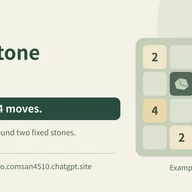
Slide and merge numbered tiles on a 4x4 board around two fixed stones, trying to reach 96 points in no more than 24 moves, with retries allowed.
A stuck elevator, a smell and a handful of suspects: only the culprit lies, so weigh every statement, mark who is innocent and accuse the one who did it.
Picture a sheet of paper that has been folded and punched, then tap the grid where every hole will land once it opens, in three puzzles of rising difficulty.
Combine the numbers on your dice with arithmetic operations so that each roll comes out to exactly 37.
Manage a $10,000 bankroll through five rounds of replayed historical price charts, choosing leverage or cash to ride rallies and dodge crashes.
Solve a logic grid laid out like an English parish map, where numbered fields hold the clues and a built-in tutor can show the next forced deduction and its reason.
Assign each animal to its house by deduction as fresh sets of clues about house colors and positions arrive step by step, with each house holding one or two animals.
Copy a small target picture onto a blank canvas by rolling one color across an entire row or column per move; each roll paints over what came before, so order matters.
Spend a budget buying your own pieces, then try to checkmate the bot on a small board with the fewest moves you can, measured against par and the day's top result.
Craft a regex as short as you can that matches every target string while leaving the innocent decoys alone, with a par length and a featured technique such as anchors.
Quick visual-logic rounds, five a day, ask you to finish a sequence or matrix, spot the rule-breaker or apply a transformation, with a score from 0 to 100.