Sumdinger
gamefinity.io · Math & Logic
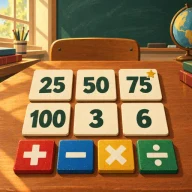
Keeps the fixed target that sets Mathler apart, but you build the sum in the open: six number cards, the four basic operations and three targets a day, with no hidden equation to deduce.
Mathler, from the small studio Hey Good Game, flips the usual math quiz around: the answer is shown, and the equation behind it is hidden. On the Normal level you get six tries at filling six squares with digits and the four operators, and each guess must itself work out to the target. Each tile then changes color, green for placed, yellow for misplaced and gray for absent, and multiplication and division come before addition and subtraction. Working backward from a number you already know is what makes it click.
Sumdinger leads because it shares the target-number arithmetic, building a sum from number cards. The nearest equation-deduction games follow, Calcle and Nerdle among them, then Countdown-style target games, and finally a grid puzzle that Mathler's own page recommends and a digit code to crack with colored feedback.
Keeps the fixed target that sets Mathler apart, but you build the sum in the open: six number cards, the four basic operations and three targets a day, with no hidden equation to deduce.
Probably the nearest twin: the result is on show as in Mathler, the operators are fixed in their slots, and only the digits are yours to work out, across five attempts with colors after each one.
The familiar cousin with one clue fewer: you deduce an eight-character equation in six tries using colored tiles, but the result is hidden too, so there is no target to work backward from.
Close to Mathler in feel: six goes at a concealed equation, every entry a real calculation, with green marking a correct position and brown flagging a digit or operator that sits in the wrong slot.
Shares Mathler's target number but drops the color-tile guessing: you combine the provided numbers into an expression that hits it, Countdown style, and a second bonus target is there for extra credit.
Six small numbers and the basic operations must land precisely on the day's target, and a difficulty rating that varies by day tells you what you are in for, a build-it-yourself complement to Mathler's deduction.
Raises the target into three digits: six number tiles, any of the four operations, and the aim of hitting it exactly or landing as near as possible, a looser goal than Mathler's must-equal rule.
Five targets a day that climb in difficulty, each built from six supplied numbers using the four operations, with every number available once, a longer arithmetic session than a single Mathler grid.
Seven sums a day against the clock: six numbers combine toward a three-digit target, from 101 up to 999, with a two-minute limit on each, adding time pressure to the arithmetic.
Reaches the target in stages instead of one line: you combine tiles two at a time over no more than five steps, each tile used once, and every subtotal can feed a later step.
The puzzle Mathler's own page recommends to its players: you cross out numbers so that what remains in every line matches the total printed beside it, with a clock running and boards in two sizes.
In Mathler the result is given and you hunt for the equation that produces it, so every guess must equal that number. Nerdle hides the result as well, and you deduce the whole eight-character equation. Mathler also offers four levels, from a five-square Easy puzzle to Hard with parentheses and Extreme without yellow hints.
Yes. Commutative solutions count, so reordering the terms of a sum does not cost you, and the game rearranges your entry to match the stored solution. Digits and operators may appear more than once, and the order of operations applies, so times and divide are calculated ahead of plus and minus, which matters when you plan a first guess.
Yes. A new puzzle appears each day at every level, Practice mode serves unlimited extra puzzles, and an archive lets you replay past days. The game is free with no sign-up required, though a free account adds saved stats, streaks and leaderboards for anyone keeping track of a run.