Clues by Sam arranges twenty people in a grid of four columns and five rows, each with a name and a job such as cop, cook or singer, and asks you to sort them into innocent and criminal. You start from one revealed clue, and declaring someone's status can uncover another. Everybody tells the truth, criminals included, and neighbors count diagonally, so one person can have as many as eight. The game refuses any choice the clues do not prove, which makes each solve feel airtight.
Every pick here runs on proof rather than hunches. Games with suspects and statements lead, beginning with a game that uses the same truthful-suspect grid, then classic people-and-attributes logic grids and a scheduling puzzle, and finally two placement puzzles whose row, column and neighbor rules will feel familiar to anyone used to Clues by Sam's boards.
The closest relative on the list: three cases a day on boards holding between 16 and 25 suspects, all of them honest, and like Clues by Sam it lets you call someone guilty or innocent only after the clues prove it.
A comic twist on the suspect line-up: a stuck elevator, a bad smell and a few suspects, where only the guilty party lies. It reverses Clues by Sam's all-truthful rule, so spotting the false statement becomes the key deduction.
Keeps the whodunit framing but moves it into rooms: you move suspects and weapons between rooms until all the true statements agree, and the room with both murderer and weapon solves the case. Difficulty climbs toward Sunday, as in Clues by Sam.
A crime set in France and solved card by card: 40 people, places and objects wait face down, each to be turned only when the clues in your notebook justify it, and every flip adds a clue, much as each Clues by Sam reveal does.
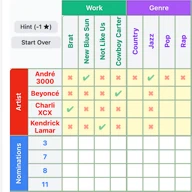
Also arranges people on a grid by reading their clues, but instead of judging each person you work out where everyone sits, which points to the day's relic. Side puzzles include Mosaic, about shapes, and a Rosetta-style decoding challenge.
A row of people and a set of statements about them: you deduce each person's attributes, the Einstein-style cousin of Clues by Sam with traits in place of guilt, and older puzzles can be printed out.
A plainer route to the same satisfaction: a few clues plus a marking grid that pairs people with traits such as names, ages and surnames, with past puzzles to return to when today's is done.
One classic grid logic puzzle a day, linking each person to facts such as a spouse and a wedding year, using a small set of numbered clues, a calm daily habit for Clues by Sam players who like tidy elimination.
Adds a little general knowledge to the logic grid: you pair people with their traits by reading written clues, a few of which call for some trivia, and hints take stars off your rating.
Constraint logic in a different setting: you fit events onto a calendar month so that every rule is satisfied, and fresh events, rules and disruptions turn up partway through, much as each Clues by Sam reveal changes what you know.
Grid deduction with counts on each line: you plant 12 flowers so each row and column matches its printed number and each arrow aims at one, marking soil where nothing can grow, a lot like tagging innocents.
A neighbor-based placement puzzle: exactly two mushrooms go in each row, column and colored patch, and none may touch, diagonals included, the same eight-way idea of neighbors that Clues by Sam relies on.
No. The game only lets you make a choice the revealed clues support, so a 50/50 hunch is never accepted. If it stops you, you have probably missed something rather than found an error, since the puzzles are checked by algorithm. A hint button, plus an Inspect button that explains the wording of a clue, helps when you are stuck.
What do words like neighbors and above mean in Clues by Sam?
Neighbors include diagonal ones, so a corner person has fewer than someone in the middle. Rows run across and are numbered 1 to 5, columns run down and are lettered A to D, and 'above' or 'below' refers to anywhere within that column. 'Both' means exactly two, numbers are exact unless a clue says otherwise, and a profession proves nothing by itself.
Do Clues by Sam puzzles get harder during the week?
Yes. Difficulty rises from Monday through Sunday; the Wednesday puzzle on November 4, 2026 was labeled Tricky. Signing up for a free account saves your results history and opens the previous week's puzzles, and Puzzle Pack #2 offers all-new cases for anyone who wants to support the game. Alibi follows a similar climb toward the weekend.