These games take the familiar five-letter word hunt, with its green and yellow letters, and run several boards off one keyboard. Every guess goes onto each board still in play, each board colors it against its own answer, and the whole set shares one budget of guesses, so a useful guess has to help across many boards.
They are listed by how many boards they deal: two, then four, eight, sixteen, thirty-two and sixty-four. The guess budget grows more slowly than the board count, from seven tries for two words to 70 for 64, so the larger games reward guesses chosen to test many letters at a time over guesses aimed at one board.
Several add modes of their own: solving the boards in a fixed order, starting from words the game picks for you, or racing a clock. The credits on the 64-board version trace its line back through the 16-, 8-, 4- and 2-board games to the original single-board puzzle.
The two-board starting point: one keyboard feeds both puzzles, each board marks your word against its own answer, and seven tries must cover the pair. Progress saves as you go, and it keeps stats and streaks.
Also a pair of five-letter answers, with nine shared guesses in place of Dordle's seven, which leaves more room to test letters before you commit. It sits on a site of solitaire, mahjong and quiz games.
Two boards solved side by side, but with four-letter answers instead of five and twelve rows to crack both; each entry is marked on the two boards at once.
The four-board classic, with nine guesses to clear all four, hosted today by Merriam-Webster. Extreme and Chill change the guess count and the word list, Sequence fixes the order of the boards, and Rescue starts you off from a computer's poor opening.
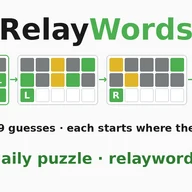
Four boards and nine shared guesses, run as a relay: every word has to open with the letter that ended the word before, and solving one leg reveals the first letter of the next. Naming the theme on themed days adds points.
Eight boards share 13 guesses, also hosted by Merriam-Webster. Each entry is tested on all the boards left open, and a practice mode lets you play beyond the daily.
Sixteen boards at once. Besides the standard daily it has Sedec-order, where the words must fall one at a time, Savior, where the opening four guesses are made for you, and variations with word lengths between four and eleven letters.
Thirty-two boards and 37 guesses. Its daily set adds Sequence, which shows each board only after the last is solved, Jumble, which opens with three random words, and a Crosswordle puzzle, with global and private leaderboards.
Pick your own load, anywhere from one board to 32, and play the daily either with limited turns and no clock or as a timed speedrun with unlimited guesses. Marathon and multiplayer modes go further.
The far end of the format: a 64-board set, each guess applied to every board, with 70 tries in all. The boards can be laid out in 4, 8 or 16 columns, and a free-play mode runs beside the daily.