
How Many
gamefinity.io · Other
Closest to Amountle's glance-and-guess moment: beans, sheep or stars crowd the screen for an instant, you put a number on them, and the average of every player's answer shows how your eye compared.
Amountle is a daily estimation game about piles. Objects tumble into a container, and the one instruction is not to count: you watch the heap, spin it with a drag or shake it with a tap, and type your guess on a keypad before a short timer runs out, over five rounds. Every day gets its own number and theme, such as puzzle 308, a shelf that asks how many are inside. Over/under, fill and survival modes sit beside the daily, plus a five-game gauntlet. Sharp eyes matter more here than careful arithmetic.
How Many sits at the top because it asks the same question of a crowd that flashes past. Next come games where you judge a quantity by eye, whether pieces, weights, sizes or speeds, then two pouring games close to Amountle's fill mode and a few number guessers that echo its over/under round.
Closest to Amountle's glance-and-guess moment: beans, sheep or stars crowd the screen for an instant, you put a number on them, and the average of every player's answer shows how your eye compared.
Also asks how many objects sit inside a container, a tub of pasta pieces for example, but from still photos rather than a live drop, with three guesses to narrow down the right figure.
A count by eye with a theme: a LEGO set is shown and you judge its piece count, then refine the number guess by guess with no cap on attempts, a gentler pace than Amountle's timer.
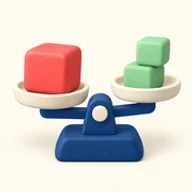
Trades piles for a balance scale: you judge how many house cats, bowling balls or other everyday items it takes to balance something heavy, for five objects in a row, using the same feel for quantity Amountle trains.
Another scale game: you weigh up the number of one thing needed to offset another, with pairings as lopsided as grapes and giraffes or paperclips and rockets, across five weighings each day, a playful step on from counting what you see.
Swaps a number of objects for a size: photos of five museum objects hide anything that would give away scale, and you slide to your guess at the length of each one's longest edge, an eye test like Amountle's.
Judges motion instead of a pile: you see two reference runs at known speeds, one slow and one fast, then put a figure on how quickly a third vehicle moves, scoring as many as 1,000 points a round over five rounds.
Close to Amountle's fill mode: you press and hold to fill five strangely shaped, unmarked glasses, letting go at a target level that is judged by volume, so the shape of each glass can fool your eye.
A blind pour into three glasses: you hold to fill each one once, aiming for the top line even as a curtain hides part of the view, and any spill scores nothing, so estimation meets nerve.
Mirrors Amountle's over/under mode with trivia instead of piles: each line sets a number, and you call whether the real figure sits above or below it, alone or against other players.
Turns the estimate into trivia: five questions answered on a slider, where every step off costs a point out of 100, and afterward you see how other players guessed on the same questions.
No. The game tells you outright not to count and to watch the pile instead, and the practice round gives you about 15 seconds before you type a number. You can drag to spin the container and tap to shake it, which lets you see the heap from other angles, but the point is a quick estimate, not a tally.
The home screen lists over/under, fill, survival and practice modes, a leaderboard, an option to duel a friend and a daily gauntlet that combines five games into one score. A weekly calendar tracks your streak, and there is an achievements page. Each daily is numbered and dated, so you always know which puzzle you are on.
How Many shows beans, sheep or stars for a moment and asks for a count, then reveals the average answer, while Estimate Me and Brickdle ask how many objects sit in a container or how many pieces make up a LEGO set. Tilt and Weighsies keep the counting but move it onto a balance scale.