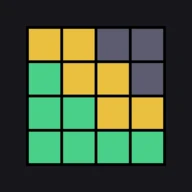
Quordle is Wordle on four boards at once: every five-letter word you type is checked against four hidden answers, and each board colors it separately. The Classic daily gives you nine guesses to clear all four boards, and a board stops taking guesses once its word is found.
Quordle takes Wordle's colored tiles and multiplies the boards: four hidden words, one keyboard, and every guess written on all four grids at once. A word that does nothing for one board can crack another, which is why it plays as one puzzle rather than four Wordles in a row.
This page sets out the rules as Merriam-Webster's version plays them, colors one made-up guess on four boards, gives the habits that keep nine guesses from running out, and covers the versions with two, eight, sixteen and thirty-two boards for days when four feels like too few or too many.
The rules in one minute
Four empty grids sit above one keyboard, and each hides its own five-letter word.
Type a real five-letter word and press Enter. It is written on every board that is still unsolved.
Each board colors your guess against its own answer, as Wordle does: green for a letter already in its place, yellow for a letter that word has somewhere else, gray for a letter it lacks.
A board stops filling once its word is found, so later guesses only count on the boards still open.
Solve all four within nine guesses to win the Classic daily. If any board is still open after the ninth guess, the game is lost.
The four-board daily itself, on Merriam-Webster's site: nine guesses in Classic, plus Extreme with eight guesses and stranger words, Chill with twelve and friendlier ones, Sequence one board at a time, and Rescue, which starts you on a board the computer has already played badly.
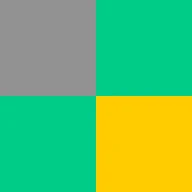
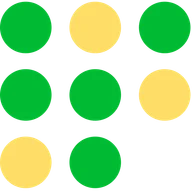
Here is one invented guess on four invented boards, with a different secret word on each. The same five letters come back with four different sets of colors, and each set narrows a different answer.
CRANE
CRANE
CRANE
CRANE
Made-up example, not from any day’s puzzle. The guess CRANE on four made-up boards, the first at the top. Their words are TIGER, CLOAK, SHINE and PLANT, and each board colors the guess against its own.
Board 3 already has its last two letters: whatever its word is, it ends in NE.
Board 4 has A and N in the middle, and board 2 starts with C and has an A somewhere other than third place.
Board 1 learned the least: an R and an E somewhere other than where CRANE put them, and no C, A or N.
So the second guess should test fresh letters while trying R and E in new spots, which helps board 1 most and still colors the other three.
Habits that save guesses
Spend the first two or three guesses on letters, not on any one board. With four answers in play, a word that tests five new common letters is worth more than a near miss on one grid.
Once a board is down to a single possible word, play it. A solved board stops taking guesses, and every guess after that works only on the boards you still need.
Read every board after every guess. A word chosen for one grid still colors the other three, and the best clue of the turn is often on a board you were not thinking about.
Count before the end. With nine guesses and four words, you can afford about five guesses of searching if each word then takes a single guess to finish, so do not let the search run past the fifth.
Fewer boards, or more
The same idea comes in other sizes, each free in a browser with no account. Two boards are a gentle start; eight and more turn it into a game of bookkeeping.
Two boards from one keyboard and seven tries to solve both, the easiest step up from Wordle. Guesses are saved as you go, so a half-finished pair can wait, and stats, streaks and a share line come with it.
Eight boards and 13 guesses in the Classic daily, with Chill at 16 and Extreme at 12. Sequence shows one board at a time with 15 guesses, and earlier days sit in an archive beside a practice mode.
Sixteen boards answered together, every guess counting on each grid, plus a mode where the boards come in order and another that opens with four words already chosen for you.
Thirty-two hidden words and 37 guesses, so the four-board habits matter even more. Extra modes include Sequence, Jumble, which starts you with random words, and a Crosswordle variant, and there are global and private leaderboards.
The rules come from Merriam-Webster's Quordle and Octordle pages and the other picks' own pages. The four boards in the example were made up for this page and colored letter by letter. All 5 picks were opened in a phone-sized browser between November 4 and November 10, 2026 and loaded, and each one fit the screen without sideways scrolling.
What is the difference between Wordle and Quordle?
Wordle hides one word and gives six guesses. Quordle hides four, each on its own board, and gives nine guesses in its Classic daily, with every guess checked against all four boards at once.
How many guesses do you get in Octordle?
Thirteen in the Classic daily, for eight words. Chill allows sixteen and Extreme twelve, and Sequence, where the boards come one at a time, allows fifteen.
Is Quordle free?
Yes. Quordle plays free in a browser on Merriam-Webster's site with no account, and Octordle, Dordle and Duotrigordle are free in the same way.