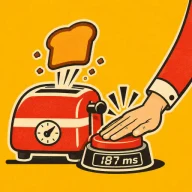
Daily reaction time games give every player the same short set of reflex or timing tests and score how fast or how exactly you respond. Butterflinch has you press the instant your toast pops, ten slices a day, Reaction gives one timed attempt once the signal turns green, and Timed asks you to hold a button for a stated number of seconds.
Which daily games test timing rather than speed?
Timingle asks for a press exactly as a countdown reaches zero, Darkroom has you pull each photo from the developer by a silent count, and Dialed’s Time Game plays five durations for you to hold again from memory.
These games measure your hands and your internal clock rather than what you know. Some are pure reflex tests: wait for a cue and press as fast as you can, without jumping the gun on a decoy. Others ask for precision instead of speed, stopping a countdown at zero, holding a button for an exact number of seconds or pouring until a glass is full.
Because every player gets the same daily set, usually with a single attempt, a result can be compared with a friend’s. The last group mixes reflexes with judging by eye, such as counting flashed dots or setting an angle, for anyone who wants a varied few minutes of tests. Screens and mice add small delays of their own, so scores compare most fairly between people on similar devices.
Ten slices a day, and you press the moment the right bread pops, while the toaster tries to bait you with twitches, dings, hops and the wrong bread. The first three are straight speed tests; a press on a trick scores nothing, but the run carries on.
The plainest reflex test there is, once a day: hold still until the screen goes green, then click as fast as you can. Jumping early ends the attempt, and the result comes in milliseconds, kept beside your own earlier days.
Five tiny tests of hands, eyes and memory, with a claim made first: before playing you predict your average, from 40 to 100, and the share card sets it against what you actually scored.
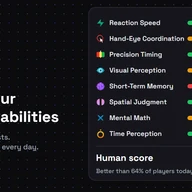
Eight short tests back to back, from reaction time and aim to timing, memory, perception and mental arithmetic, each worth up to 100, summed into a single score for the day.
Reflexes in arcade form: tap to flip a dart from side to side as it races down a winding tunnel, threading rings for points and missing the walls. The daily run is the same for all, and Free Play allows more.
A five-part timing gauntlet, the same for everyone each day: halt a marker as it sweeps past, catch a target on its orbit, guess where a dot went after it vanished, hold a beat in silence and respond to a flash.
No clock on screen at all: you are given an interval, 4.3 seconds for example, and hold a button until it feels up. Five intervals a day with one attempt, on the same site as Freehand.
Hold to pour and let go at the top line, three glasses a day with one try each. A curtain drops partway and hides the glass, so the end of the pour is judged blind, and any spill scores zero.
Thirty gates that keep narrowing, flown by tapping to rise and letting go to fall. Brushing a wall ends a run, and of the day’s three attempts only the one that gets furthest counts.
A one-button test of your inner clock: dip each print, count the job card's seconds without a clock, and pull it while the day's darkroom tries to throw your count. Five jobs, shared by everyone.
Dialed’s clock test: five durations are shown in turn, then you press and hold to reproduce each one, with no timer to watch. Up to 10 points per hold, 50 in all, and the daily set is one attempt for every player.
Six small daily games of judging by eye, five rounds each: halve an object by weight, predict where a throw lands, copy an angle, count a crowd, hold for a set time and find a balance point, with one attempt at each.
Five quick perception tests in about two minutes: guess a count of flashed dots, predict where a vanishing ball lands, drag a line to an angle, keep tapping a beat after it stops and mark a fraction. Unlimited rounds follow.
Five rounds of measuring by eye, shared by all players each day: count dots that flash briefly, pour to an exact percentage, set an angle, hold for a given number of seconds and match a line’s length.